
Please Leave Us A Message
Privacy statement: Your privacy is very important to Us. Our company promises not to disclose your personal information to any external company with out your explicit permission.

 Product Categories
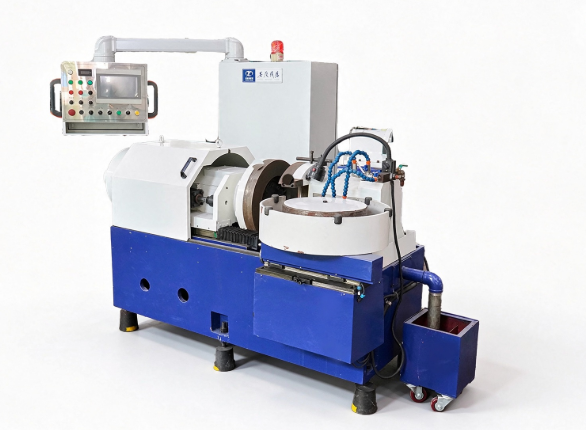
Classify before you touch anything: length, direction and clustering identify the source faster than any measurement. Inspect under diffused light first, then at 90× magnification — the industry's standard visual check for lapped surfaces. What looks like one defect at arm's length is usually four different defects under the loupe.
| Signature | What you see | Most likely cause |
| Long, repeating arc or spiral | Continuous line following the ball path | Groove wall wear, plate runout, a raised burr on the plate face |
| Deep random gouges, few per ball | Isolated, sharp-bottomed, varying depth | Hard debris: broken abrasive, chip, swarf in slurry |
| Clustered short scratches on part of the batch | Localised to one area or one groove | Groove chipping, plate damage, loading damage |
| Fine matte haze, no single line | Overall dull surface, no discrete scratch | Abrasive too coarse, slurry too concentrated |
| Scratches appearing only after washing | Clean balls, marked after cleaning | Grit carried over between stages or dirty drying |
The difference between a scratch and what Chinese operators call "grinding damage" matters here. A true scratch is a line cut by a hard particle or edge. Grinding damage is a shallow pit with a rough bottom and crossed marks, caused by balls intermittently slipping in a groove instead of rolling. The two look similar at a glance and have completely different fixes: scratches need the particle removed, damage needs the groove geometry restored.
✅ Bottom line: Read length, direction and clustering before adjusting anything — the scratch signature names the source faster than a parameter log.
Work from the cheapest fix to the most expensive, and verify after each change on a small batch rather than the full load. Sorting through steel ball lapping scratches causes and how to fix lists online usually produces one long checklist that mixes causes across stages; the sequence below is ordered by cost of intervention, not by likelihood.
Step 1 — Slurry and cleanliness (minutes, no downtime). Filter or replace the slurry, check concentration, and confirm grit size matches the stage. Most sudden scratch outbreaks after weeks of good production trace to a slurry change, a top-up with the wrong grit, or a filter that was cleaned less often than the plate. Confirm the grit certificate with your supplier before assuming the machine changed. Drain, flush and refill before touching the machine.
Step 2 — Plate and groove inspection (one shift). Look for a raised burr on the plate face, chipping on groove walls, and depth loss in the grooves. Grooves worn past roughly two-thirds of ball diameter cause slipping, and slipping produces both grinding damage and the clustered scratches that operators usually blame on material. Light burrs can be dressed out; deep chipping means the plate is done.
Step 3 — Loading and handling (no cost). Check how balls enter the machine. Dropping a 250 kg load from height dents balls against the plate edge and creates the localised damage that shows up later as clustered marks. Load in a controlled flow, and never mix a partially used load with new balls.
Step 4 — Cross-stage contamination (process change). If scratches appear only after washing or between two lapping stages, the cause is carry-over: grit from a coarser stage sitting in a tray, a cloth, or a drying basket. This is the classic explanation for what causes deep scratches on lapped Steel Balls in plants where each individual machine is demonstrably fine. Segregate baskets, tools and wash liquor by grit, and clean between grades.
Step 5 — Plate geometry (planned downtime). When nothing else removes the marks, measure plate flatness and spindle runout. A plate that has dished transfers its shape to the batch, and the marks repeat with the plate's period. This is the point where lapping plate groove chipping causing ball scratches stops being a hypothesis and becomes visible — chipped groove edges cut a line on every pass, and no amount of slurry filtering will help.
Two rules shorten the loop. First, always keep a retained sample of the last good batch; comparing a scratched ball to a known-good ball under the loupe is faster than any instrument. Second, change one variable at a time and run a 20 kg verification batch — full-load trials after every hypothesis burn a week of production, which is why most steel ball lapping scratches causes and how to fix searches end with parts replaced that were never faulty.
Anqing Machine Tool Co., Ltd. supplies replacement plates, groove dressing support and process review for lapping platforms in the field, and as the drafter of China's industry standards for steel ball lapping machines the company treats scratch diagnosis as a process question with a documented answer rather than a warranty argument.
✅ Bottom line: Fix slurry first, inspect grooves second, geometry last — and verify each change on 20 kg, not a full load.
Q: Do scratches always mean the lapping machine is worn out? A: No. Most scratch events are slurry or contamination problems that cost nothing to fix. Machine wear shows up as repeating marks with a fixed period and as roundness drift, not as random gouges — random gouges are the usual answer to what causes deep scratches on lapped steel balls, and they start in the slurry tank far more often than in the spindle.
Q: How often should lapping plates be dressed or replaced? A: On condition, not on a calendar. Check groove depth and plate flatness weekly; dress when the groove profile rounds off, replace when depth falls below about two-thirds of ball diameter or when chipping appears on groove walls — edge chipping is the clearest early warning of lapping plate groove chipping causing ball scratches, so inspect groove edges, not just depth.
Q: Can you supply plates and spares for machines already in service, including OEM builds? A: Yes. Anqing Machine Tool supplies cast iron plates, resin wheels and spares for 3M-series lapping platforms, and builds custom plates to ball diameter and target grade; wholesale plate orders covering several machines are quoted as a set. Share your model, ball size and current defect with photos under magnification, and the factory will recommend the plate specification rather than a generic replacement.
Post a single defective ball with a photo at 20× and 90× magnification plus your plate age and slurry routine, and Anqing Machine Tool will return a written diagnosis naming the likely source and the intervention order. It takes one envelope and saves the trial-and-error week.
Phone:+86 18055626858
Mail:529588185@qq.com


ANQING MACHINE TOOL CO.,LTD
EMAIL : info@aqballgrinder.com
ADD. : No. 136-1, Jixian North Road,, Anqing, Anhui China
Privacy statement: Your privacy is very important to Us. Our company promises not to disclose your personal information to any external company with out your explicit permission.
Fill in more information so that we can get in touch with you faster
Privacy statement: Your privacy is very important to Us. Our company promises not to disclose your personal information to any external company with out your explicit permission.