
Please Leave Us A Message
Privacy statement: Your privacy is very important to Us. Our company promises not to disclose your personal information to any external company with out your explicit permission.

 Product Categories
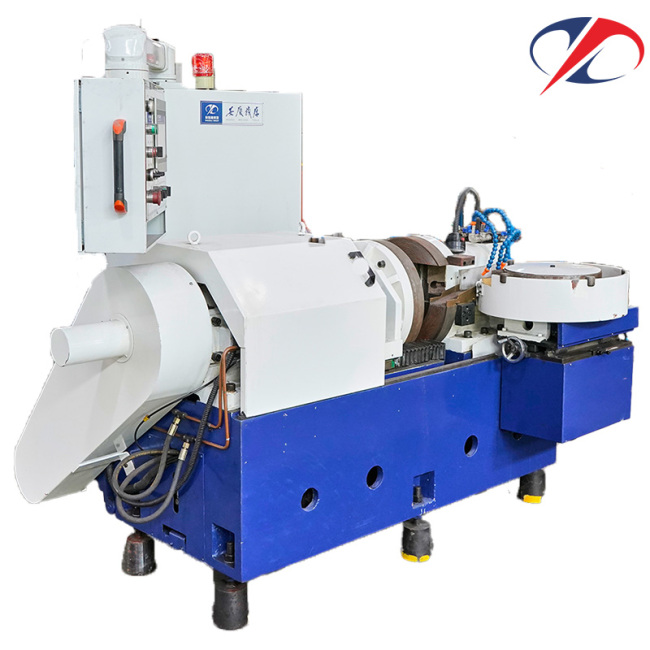
After heat treatment, bearing balls are hardened to 60–66 HRC and ground between two rotating abrasive discs. The disc speed (the spindle speed, expressed as peripheral velocity) is kept roughly constant because the abrasive works best in a narrow velocity window. What the material changes is:
So when an engineer asks for settings "by material," the honest answer is a family of feed-and-pass recipes built around a fixed speed band, not a single RPM. Anqing Machine Tool treats material as the master variable; invert that and you fight burns.
The disc peripheral speed below is a starting band for resin- or vitrified-bond discs on a twin-disc hard grinder. Convert to RPM by your disc radius. Feed and passes are relative levels — tune on your media.
| Material | Disc peripheral speed (m/s) | Feed / pressure level | Typical passes | Coolant note |
| Bearing steel GCr15 / 52100 (60–64 HRC) | 30–35 | Medium | 3–5 | High flow, 4–6% conc. |
| 440C stainless (58–60 HRC) | 28–33 | Low–Medium | 4–6 | Sharp media, avoid loading |
| 304 / 316 stainless (annealed, work-hardens) | 26–32 | Medium | 3–5 | Strong cooling, watch hardening |
| Carbon / low-alloy steel (pre-hard) | 32–38 | High | 2–3 | Standard emulsion fine |
| Brass / soft non-ferrous | 22–30 | High | 1–2 | Low pressure, avoid embed |
If your part is a contoured seat rather than a sphere, a Spherical Base Surface Magnetic Non-magnetic Grinding Machine runs a different velocity profile because the contact geometry is curved — do not copy flat-disc numbers onto it without a trial.
Anqing Machine Tool validates every recipe on a trial batch before release.
The companion half of the recipe is feed rate settings for steel ball hard grinding by material. Feed here means how aggressively the charge is presented and how hard it is pressed into the disc gap — and why a custom media blend matters more than a tenth of an RPM. Hard, brittle grades want a lighter, steadier feed so the disc cuts instead of rubbing; softer grades take a heavier feed and still finish clean.
A steel ball grinding machine technical specifications φ3 φ20 mm matters because the same machine behaves differently at the ends of its range. Below are the capability numbers a process engineer should confirm before quoting a job in this band.
| Spec | At φ3 mm | At φ20 mm | Why it moves |
| Disc diameter | 600–900 mm | 900–1200 mm | Larger balls need a larger active face |
| Spindle speed range | 200–400 RPM | 120–240 RPM | Same peripheral speed, bigger radius → lower RPM |
| Charge per batch | 20–30 kg | 80–110 kg | Mass, not count, drives the load |
| Installed power | 7.5–15 kW | 18.5–37 kW | Larger charge, higher torque |
| Dressing interval | Every 2–4 batches | Every 3–6 batches | Smaller balls load discs faster |
Note the counter-intuitive part: at φ3 mm you run a higher RPM but a smaller charge mass, because the disc is working many tiny balls with less total load. At φ20 mm the RPM drops but the batch mass and motor power climb.
Anqing Machine Tool covers the full φ3–φ20 band on one frame, so you change settings, not machines. Most machine manufacturers publish only the φ20 number and hope you never run φ3.
Q: Can I just run every material at one spindle speed and only change feed? A: When you set spindle speed settings steel ball hard grinding by material, a narrow hardness band (say all 60–64 HRC bearing steels) lets you keep the speed in the 30–35 m/s band and vary feed and passes. The moment you cross into stainless, brass, or pre-hard carbon, the speed band itself shifts, so change it too. One speed for everything is the most common cause of mystery burns.
Q: My discs load up fast on 304 stainless — is my speed wrong? A: Usually not the speed; it is feed-and-coolant. 304 work-hardens and smears into the disc. Lower the feed slightly, sharpen or dress more often, and push coolant concentration and flow up before you touch the spindle speed.
1. Do these settings apply to a lapping or polishing machine? No. A Lapping Ball Machine and Polishing Ball Machine run far slower with loose or bonded fine media; the numbers above are for the hard-grinding (abrasive disc) stage only. The hard-grind setting decides how much work lapping inherits.
2. Should spindle speed change with ball diameter at the same material? Within a material, keep the peripheral speed band constant and let RPM follow the disc radius — so yes, RPM drops as you go from φ3 to φ20, but surface speed stays put. A factory test on your exact media confirms this; never hold RPM constant across diameters, because that silently changes the cut.
3. Where do the balls come from before grinding? Usually a High Speed Cold Heading Machine For Steel Balls forms the blanks, which are then soft-ground and heat-treated before hard grinding. The blank's hardness and oxide state (set upstream) decide how aggressive your first hard-grind pass can be.
Need a proven starting recipe for your exact ball material and diameter? Anqing Machine Tool has set up Precision Steel Ball Equipment lines across bearing steel, stainless, and carbon grades since 1955. Tell us your material, hardness, and target diameter, and we will hand you a speed-and-feed baseline tuned to our machines and media — not a generic table. For OEM builds or a custom media blend, ask when you [request a quote].
Phone:+86 18055626858
Mail:529588185@qq.com


ANQING MACHINE TOOL CO.,LTD
EMAIL : info@aqballgrinder.com
ADD. : No. 136-1, Jixian North Road,, Anqing, Anhui China
Privacy statement: Your privacy is very important to Us. Our company promises not to disclose your personal information to any external company with out your explicit permission.
Fill in more information so that we can get in touch with you faster
Privacy statement: Your privacy is very important to Us. Our company promises not to disclose your personal information to any external company with out your explicit permission.